



Kidney cyst
A kidney cyst is a benign formation that contains a clear, transparent fluid produced by the cyst walls.
Cysts can be solitary or multiple, developing in one or both kidneys. These formations can be congenital but are more often acquired during life. The main theory regarding the origin of cysts is unfavorable conditions for urine outflow through the intrarenal urinary ducts.
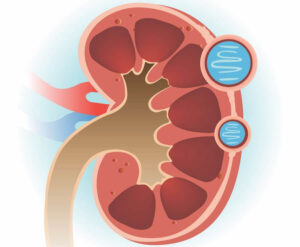
Depending on the size, nature of the contents, presence or absence of septa within the formation, and wall thickness, kidney cysts are classified as simple or complex. Simple kidney cysts are the most common. Complex cysts—fluid formations with dense septa or a solid component within the cavity—are considered potentially malignant neoplasms.
Symptoms of a Kidney Cyst
In most cases, a kidney cyst does not cause symptoms. However, as it grows, it may provoke dull pain in the lumbar region and increased blood pressure.
Diagnosis of a Kidney Cyst
The leading examination for diagnosing a kidney cyst is ultrasound. Computed tomography or magnetic resonance imaging is prescribed if a complex cyst is suspected, to distinguish it from a possible kidney tumor. These studies assess the ability of the cyst (its walls or the solid component inside) to accumulate contrast material, which is more characteristic of malignant neoplasms.
Treatment of a Kidney Cyst
Typically, a simple cyst grows slowly and has little effect on kidney function. Surgical intervention is not required for small cysts; dynamic observation is conducted: an ultrasound of the kidneys is performed every six months.
Treatment:
- Laparoscopic Excision of the Cyst
- Ablation of the Cyst.