



Prostate cancer
Prostate Cancer is a malignant neoplasm that arises from the secretory epithelium of the prostate gland. To date, a number of risk factors for the development of the tumor have been identified:
- age: the older the man, the higher the risk of developing the tumor;
- heredity: men whose relatives have suffered from prostate cancer have a significantly higher risk of developing the disease;
- dietary habits: consumption of large amounts of animal fats contributes to the development of the tumor;
- hormonal imbalance;
- smoking and harmful habits: cadmium present in tobacco smoke influences the development of prostate cancer.
With age, the incidence increases. For instance, among men under 40 years old, the prevalence of the disease is 1 in 10,000, among men aged 60 — 1 in 100, and among men aged 75 — 1 in 8. If prostate cancer has been detected in relatives, the risk increases by 4-7 times depending on age.

Symptoms of Prostate Cancer
Often, the disease does not manifest itself in any way. Typically, there are complaints related to benign prostatic hyperplasia. The main signs of prostate cancer in men are:
- weak urine stream;
- difficulty urinating;
- feeling of incomplete bladder emptying;
- frequent urination;
- urinary incontinence;
- uncontrollable urges to urinate.
Diagnosis of Prostate Cancer in Men
The successful treatment of prostate cancer depends on the timely and accurate diagnosis
A very important marker for prostate cancer is the prostate-specific antigen (PSA). Normally, the level of total PSA in the serum should not exceed 4 ng/ml. If this level is exceeded, the risk of prostate cancer significantly increases. To determine this indicator, it is sufficient to take a blood sample from a vein for analysis. Every man who reaches the age of 50 should have a PSA blood test annually.

The oldest and simplest method for diagnosing prostate cancer in men is a digital rectal examination. This method has many drawbacks, such as a very low percentage of cancer detection and the identification of the disease only in advanced stages.
Ultrasound examination (US) can also raise suspicion of an oncological process in the prostate. However, this method also has low sensitivity in detecting prostate cancer. The method can be performed either transabdominally (the ultrasound probe is placed on the abdomen) or transrectally (the ultrasound probe is inserted into the rectum).
Magnetic resonance imaging (MRI of the prostate) allows for the assessment of the condition of the prostate capsule, periprostatic tissue, seminal vesicles, regional lymph nodes, localization and size of the tumor node, and evaluation according to the Pirads scale.
Dynamic bone scintigraphy is used to detect distant bone metastases.
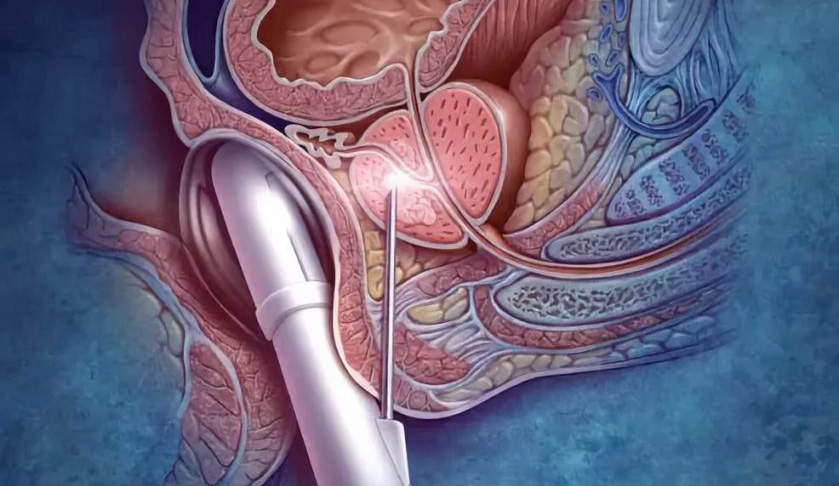
If there is suspicion of prostate cancer based on at least one of the above criteria, the next step for verifying the diagnosis is to perform a prostate biopsy, i.e., taking small fragments of the gland for histological examination.
The most progressive and modern method for diagnosing prostate cancer is
multifocal prostate biopsy under ultrasound control.
Modern Treatment Methods for Prostate Cancer
If prostate cancer is detected during histological examination after a biopsy, depending on the stage of the oncological process, the patient may be indicated for either local treatment of prostate cancer or complete removal of the prostate.
- laparoscopic radical prostatectomy
- open radical prostatectomy
In the case of advanced, inoperable prostate cancer, chemotherapy and radiation therapy or hormone therapy is performed.