



Kidney cancer
Renal tumor, like other oncological formations, represents a mass of cells that divide uncontrollably and lack the ability to specialize. The cells can have varying degrees of aggressiveness, which determines how malignant the neoplasm will be. Treatment of kidney cancer is a very responsible undertaking, especially considering that it is a relatively rare type of oncology.

Why Kidney Cancer Develops
The exact causes of kidney cancer development, like other types of oncology, are still unknown. Doctors only identify risk groups in which the likelihood of such a disease is significantly higher. Possible causes of kidney cancer include the following:
- smoking;
- arterial hypertension;
- diabetes mellitus;
- excess weight and obesity;
- harmful working conditions;
- long-term use of certain medications;
- chronic kidney failure in the final stage.
The risk of cancer also increases if a person has suffered from certain kidney diseases. One such pathology is acute kidney failure, which can precede the tumor.
What Symptoms May Indicate Kidney Cancer
The prognosis for treatment and recovery directly depends on the stage at which the disease was detected. Therefore, it is important to pay attention to the very first signs. The earliest symptoms include:
- pain in the kidney area;
- a small amount of blood in the urine;
- systemic increase in blood pressure.
As the tumor process develops, symptoms of general intoxication appear. These include weakness, significant weight loss, and decreased appetite. Due to hematuria (blood in the urine), the patient may lose a lot of blood, leading to anemia.
Types and Stages of the Disease
There are several types of kidney cancer: clear cell (occurs in 80% of cases), papillary (10-15%, the most benign form), chromophobe (4-5% of cases), collecting duct cancer (very rare form with an unfavorable prognosis), and eosinophilic adenoma, which occurs against the background of obesity.
What Stages of Kidney Cancer Exist in Medicine:
- Stage I. The tumor does not exceed 7 cm in size. It has not yet spread to the lymph nodes or metastasized to distant organs.
- Stage II. The tumor size exceeds 7 cm, but there are no lymph node involvement or distant metastases observed yet.
- Stage III. The tumor has spread to neighboring tissues and organs, and one nearby lymph node is involved in the pathological process.
- Stage IV. In addition to the tumor spreading to other organs, there is involvement of two or more regional lymph nodes. At this last stage, cancer also gives distant metastasis.
How Kidney Cancer is Diagnosed
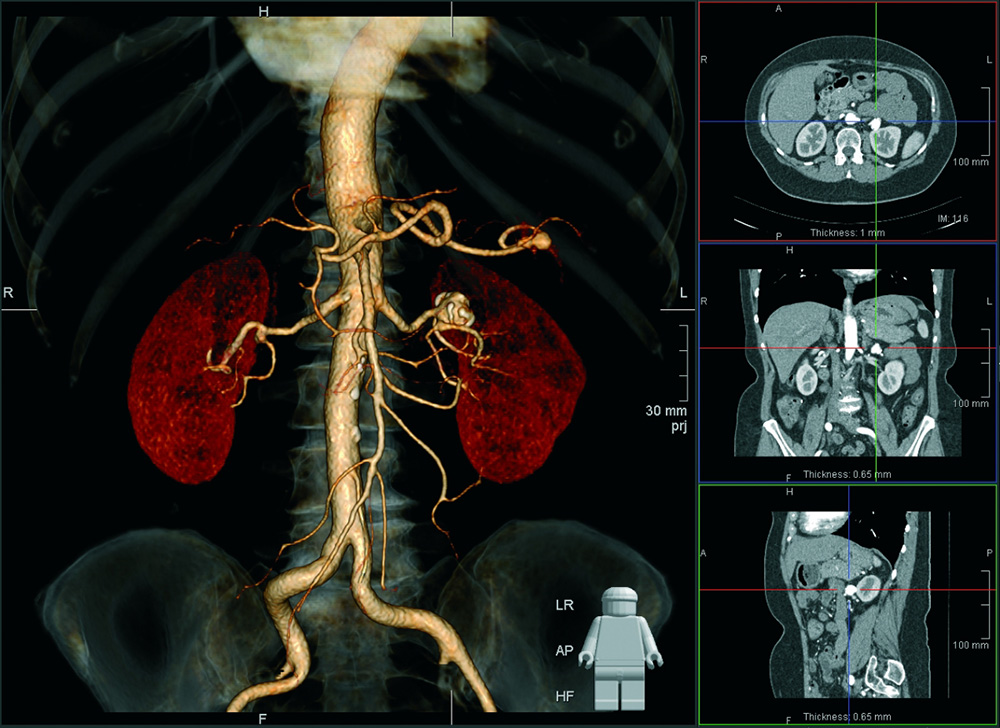
Kidney cancer is detected via ultrasound through volumetric formations in the tissue of the organ. Additionally, ultrasound allows differentiation between malignant processes and cysts. Ultrasound is considered the most informative method for diagnosing kidney cancer, as well as being accessible and safe for all patients. A downside is the difficulties in conducting diagnostics for individuals with excess weight.
What studies and tests are also necessary for a patient with kidney cancer:
- computed tomography (CT).
- magnetic resonance imaging (MRI);
- bone scintigraphy and chest X-ray if metastases are suspected;
How Kidney Cancer is Treated
Preserving the kidney is a priority direction in modern surgery for oncological urological diseases. The size of the tumor does not affect the possibility of kidney removal; in this case, everything depends on its location and the volume of healthy functioning parenchyma.
Surgical treatment methods for kidney cancer:
- Laparoscopic tumor resection of the kidney. The operation is performed through miniature incisions in the anterior abdominal wall. Performing this operation in patients with early stages is considered the «gold standard» for treating kidney cancer. Using laparoscopic instruments, the kidney with the tumor and the renal vessels are isolated from the surrounding tissues. After that, with minimal blood loss, a resection of the kidney is performed within healthy kidney tissue. The defect in the kidney is sutured with special suture material and clips.
- Laparoscopic radical nephrectomy. The operation is performed through miniature incisions in the anterior abdominal wall. Using laparoscopic instruments, the kidney with the tumor and the renal vessels are isolated from the surrounding tissues. Clips are applied to the vessels, and the kidney is removed.
- Open radical nephrectomy. Conducted through a large incision, through which the surgeon removes only the tumor or the tumor along with the kidney if there are indications for nephrectomy.
With timely treatment, the survival rate for kidney cancer reaches 90%. In this case, it is possible to avoid recurrences and metastasis. The most effective treatment method remains surgery.
Chemotherapy for kidney cancer has not found proper application, as such neoplasms are practically insensitive to antitumor drugs. Targeted therapy is most successfully used in metastatic kidney cancer.